
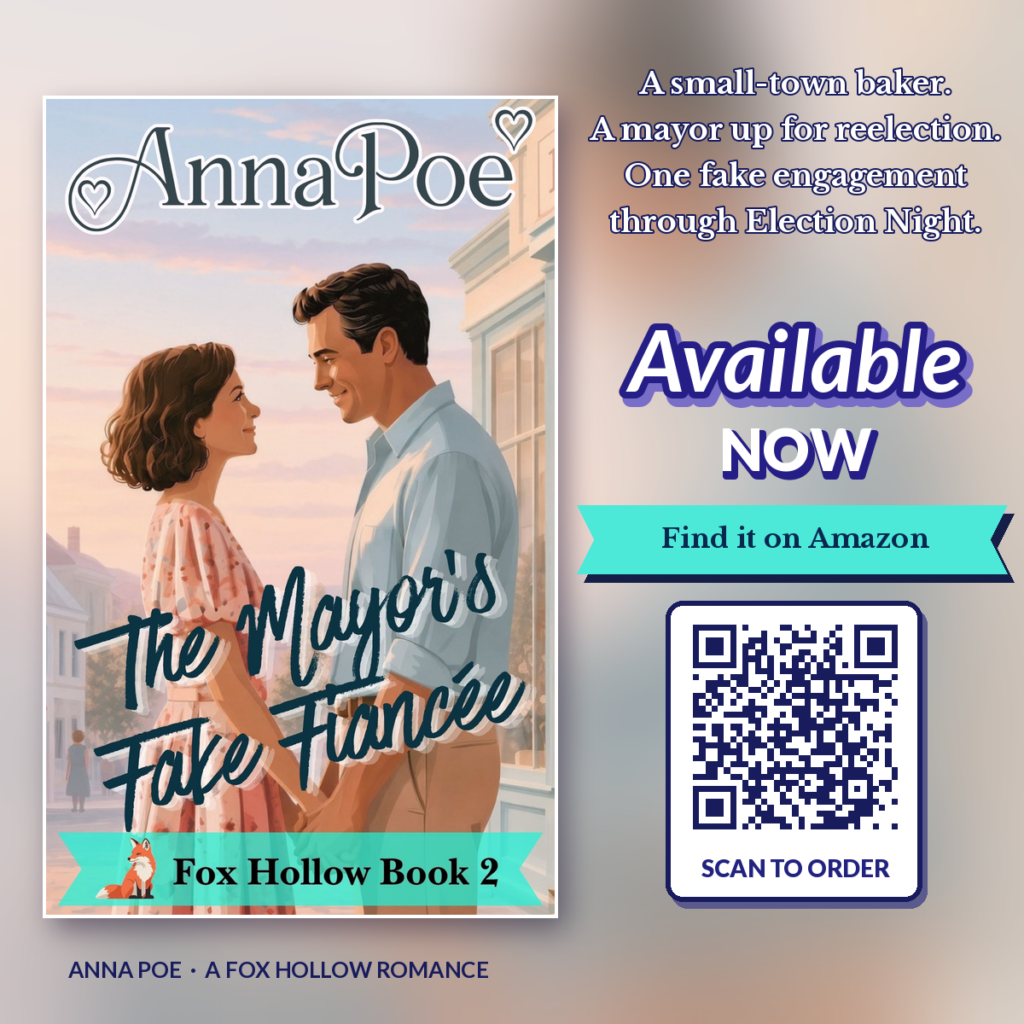
The Mayor’s Fake Fiancée is now available!
When the mayor of Fox Hollow’s reelection campaign hangs on his looking less unmarried, he offers a struggling bakery owner a $20,000 contract for a public engagement that ends Election Night — and finds himself falling for the woman who insisted on it being all in writing.
Get your copy here: https://link.amazon/B083XAyDr
Here is chapter 1:
August 1st
The Garland made a sound no commercial oven should make. Sophie’s stomach dropped before her brain caught up. She didn’t need the clock to know what that sound cost her.
She’d been elbow-deep in bourbon-pecan sticky buns at 5:30 in the morning, her favorite hour in the bakery. Outside, Fox Hollow was nothing but blue-dark streets and the hum of cicadas that hadn’t yet figured out it was too early to scream. Inside Sweet Mercy, the air hung thick with brown sugar and warm yeast, and she’d already slid the first tray into the oven, the caramel bubbling against the edges of the pan in that slow, satisfying roll that meant the temperature was perfect.
Then the shudder.
Sophie’s hands stilled over the second tray, fingers tacky with dough. She knew that shudder. The Garland had thrown tantrums all summer. A stuttering igniter in June, a temperature swing in mid-July that had turned two dozen croissants into expensive charcoal. She’d coaxed it back each time, and every morning since she’d listened for that shudder before she listened for anything else.
The pop came next, a sharp metallic snap that echoed off the tile walls, and then the digital display flickered once and went black.
“No,” she whispered. “No, no, no. Not today. Not Friday.”
She crouched in front of the oven and pressed the power button. Nothing. She pressed it again and held it. The display stayed dark.
Sophie sat back on her heels and pressed her flour-dusted palms against her eyes.
The first two failures had been manageable. Inconvenient and expensive in the way that everything about running a bakery on a shoestring was inconvenient and expensive, but manageable. She’d found a retired appliance tech in Bardstown who’d driven out for the cost of gas and a box of lemon bars, and he’d replaced the igniter and recalibrated the thermostat. Then he told herthat the Garland was twenty years old and running on borrowed time.
“She’s got maybe six months in her,” he’d said. “Maybe less, depending on how hard you push her.”
Sophie pushed her hard. She pushed everything hard. It was the only speed she knew.
She stood up, pulled open the oven door, and rescued the sticky buns. She set the tray on the cooling rack, then checked the time. Almost five-forty. The bakery opened at six. She had a standing order of four dozen sticky buns for the Rotary breakfast at the Methodist church, two custom birthday cakes due by noon, and a display case that needed to be full of something more inspiring than day-old scones.
Sophie looked at the oven. The display stared back, black and dead.
“Okay,” she said. “Okay.”
She unplugged it, waited, and plugged it back in. Nothing. She opened the back panel with the screwdriver she kept in the drawer next to the spatulas, a fact that would have horrified her pastry instructor at Valencia College, and peered inside at the tangle of wires and connectors she’d become reluctantly familiar with over the past two months. Nothing looked scorched or loose. She pressed every connection she could reach, tightened every screw that gave, and closed the panel.
She plugged it in again.
The display flickered. Died. Flickered again — and held. The temperature readout blinked 175 and began its slow climb.
Sophie leaned her forehead against the warm stainless steel.
“Thank you,” she whispered. “Just a little longer. That’s all I’m asking.”
By the time she’d remixed the dough, re-poured the caramel, and coaxed the oven through a second round of sticky buns, checking the temperature every few minutes, the morning had disappeared. The Rotary order went barely on time, but it made it.
She filled the display cases then finished the birthday cakes. And by two o’clock, when the afternoon lull settled over the square, Sophie stood behind the counter and did the math she’d been avoiding all morning.
She sold out almost every day, and she still barely made her loan and utility payments. Eggs alone had gone up twice this year. She scraped by. She made every payment, on time, and some months there was even enough left to call it a paycheck.
Now she had to face the news. A new commercial oven, nothing fancy, just a reliable mid-range Garland that wouldn’t die on her mid-Friday, was twenty thousand dollars. The number felt like a weight around her neck. She had thirty-two hundred in her business account and a hundred- and twenty-dollar balance in her personal checking. The bank in Versailles already held her small-business loan, and the monthly payments on that were the reason she ate day-old croissants for dinner three nights a week. Don Fenton’s voice was already in her head, the loan officer who’d approved her original application with the enthusiasm of a man signing a parking ticket. I’d love to help you, Ms. Callahan, but your debt-to-income ratio…
She knew her debt-to-income ratio. She lived inside her debt-to-income ratio.
Sophie wiped down the counter and looked out the front window at Fox Hollow’s town square. Despite the dead oven and the impossible math, something in her chest loosened. It always did, looking at this view.
A year and a half ago, she’d stood in one of the biggest bakeries in one of the largest theme parks in the world and realized how much she hated it — the traffic, Florida’s perpetual summer, the thousands of strangers who passed through every day and would never come back. They took pictures of the pastries. They never came back.
She’d gone to her apartment that night and pulled up a map of the United States. Where could she go? Kentucky looked perfect: four seasons, still southern enough to have sweet tea, a rich culture of food and drink. She dug further and found Fox Hollow. Just the name made her smile.
The square was the reason she’d chosen it here. Not the only reason, but the first one. She’d driven up from Orlando, fourteen hours with the stops, leaving before dawn so she wouldn’t have to find the place in the dark. It felt good to get out of the car. As she stretched, she’d looked up at the old copper courthouse dome catching the late-afternoon light, and she’d thought, Oh. There you are.
It was a ridiculous thought. She knew that. You didn’t build a life on a feeling you got from a building. Except she had. And the fact that they had no bakery in the downtown area just added to the appeal. She’d gone home, sold everything she could, gave notice at her job, and arrived fourteen months ago. It took every cent of her savings for the down payment on the building and the used equipment she’d filled the kitchen with, but she’d managed to open on August 15th.
She loved the string lights that looped between the lampposts from May through October. She loved the American flags that flew during the summer and the snowmen that hung from the lamp posts in the winter. Best of all, when she walked to the post office it took twenty minutes instead of five, because somebody always stopped her on the sidewalk to ask how she was doing and actually waited for the answer. In Orlando, she’d had a corner unit in a beige apartment complex where she’d lived for three years without learning her neighbor’s last name. Here, she knew that June Alcott on Maple Street was allergic to walnuts, that Tom Briggs at the feed store had a grandson in the Marines, that Pastor Kevin took his coffee black.
And she knew that Mayor Grayson Caldwell’s aftershave did funny things to her pulse.
Now what had brought that to mind today? She pressed her thumb against the counter edge. She hadn’t thought of him in weeks. Well, her mind had tried to go there a few times, but she always reigned herself back in.
The bell above the door jingled just after two, and Tessa Reyes blew in on a wave of August heat. She wore scrubs with a cartoon mouse on them and had her dark hair pulled back in a messy bun that Sophie had never once been able to replicate on her own straight brown hair despite multiple YouTube tutorials.
“I have twenty minutes before I have to be back on the road,” Tessa announced, dropping onto the stool at the end of the counter. “Give me something with chocolate and don’t ask me about my day.”
Sophie slid a dark chocolate brownie across the counter without a word.
Tessa bit into it, closed her eyes, and made a sound that bordered on indecent. “Okay. You can ask me about my day.”
“How was your day?”
“Terrible. Two ear infections, a broken collarbone, and a four-year-old who bit me. I look forward to the day I can make enough money with my shop that I don’t have to moonlight anymore.” She held up her forearm to display a small, crescent-shaped bruise. She took another bite and studied Sophie with the calm, assessing gaze that made her very good at her job and occasionally unnerving as a friend. “You look awful.”
“Thank you.”
“I say it with love. What happened?”
Sophie considered deflecting. But Tessa had a way of sitting quietly and waiting that dismantled her deflection like water on stone, and Sophie was too tired to be a rock today.
“The oven died again.”
Tessa’s brownie paused halfway to her mouth. “Died died, or dramatic-pause died?”
“Died died. Then dramatic-pause died. I got it running again, but I lost the whole morning.”
Tessa set the brownie down. “How bad is it?”
“Twenty thousand for a replacement.”
“And you have…?”
“Not that.” She sighed. “But I’ll figure it out. I always do.”
Tessa picked up her brownie and took another bite. “You need a benefactor.”
She snorted. “Yeah. Like I have time for a benefactor.” She propped her chin on her hand. “I haven’t even had time for a third date with Grayson, and we’ve been trying for about five months to work that in.”
“That’s because you never take a day off.”
Sophie shrugged. “A day off is a month I don’t make rent. Plus, your idea of a day off is going to your second job.” She gestured to the kitchen. “If I had a better oven, I could have faster output and would have more product to sell. That might actually give me a day off.”
Tessa slid off the stool and tossed her napkin on top of the empty plate. “I have to go open the shop. Save me a sticky bun tomorrow?”
“If the oven cooperates.”
“Talk to it nicely.”
Sophie laughed as she left, then wiped the brownie crumbs off the counter. She carried the dirty plate back to the kitchen and grabbed the bowl of risen sourdough. She’d let the loaves rise in the refrigerator overnight and bake them in the morning, provided the oven started.
‹—☙—∞—❧—›
Grayson Caldwell stopped walking on the south side of the square, half a block from the hardware store, as his phone buzzed for the sixth time since he’d left the courthouse. Four years as mayor of Fox Hollow had taught him two life lessons he never would have learned otherwise. One, every conversation was a public conversation — even the ones in the cereal aisle at the grocery store. And, two, that his campaign manager Emmett Hale could send more texts in a single afternoon than a teenager with a new phone and no parental controls.
Whitfield just posted a family photo at the farmer’s market. Wife, kids, golden retriever, matching flannels. In AUGUST. We need to talk about your image.
He stood in front of Sweet Mercy Bakery in the amber slant of a late-afternoon sun that was doing its best to remind everyone that August in Kentucky was a punishment. The bakery’s front window threw a long gold rectangle across the sidewalk, and inside, the display case stood mostly empty, the pendant lights glowing warm against the pressed-tin ceiling Sophie Callahan had hung them from when she’d opened the place last summer. He’d noticed them the first time he’d walked in. Schoolhouse pendants, brushed brass, spaced at eighteen-inch intervals. Good instincts. Most people over-lit a space like that, turned it clinical. She’d gone warm and close, and it worked.
He noticed things like that. Occupational hazard. He’d been a licensed architect long before he’d been a mayor, and he still thought in materials and sightlines and the way light moved through a room the way other people thought in words. He’d designed the restoration of the Henley Building on the east side of the square, and the new façade for the library, and the bandstand in the park that the town used for the summer concert series. All pro bono, because the town couldn’t afford his rates, and because his rates didn’t matter. The Caldwell money — lumber money, coal money, old money, fossilized in trusts so long nobody remembered the trees — meant that Grayson had never needed to work a day in his life. He worked anyway, because the alternative did not appeal.
His phone buzzed again.
I’m serious, Gray. The man is running on vibes and a photogenic family and it’s WORKING. Latest numbers have you up six. That’s down from twelve in May.
Grayson typed back with his thumb:
I’m not wearing a matching flannel.
Emmett:
That’s not what I’m saying and you know it.
He knew what Emmett was saying. He’d known what Emmett was saying for weeks. Grayson Caldwell was unmarried at thirty-five. He lived alone in the big sprawling house and had not been seen with a woman in any publicly documented capacity in months. In a town like Fox Hollow, where people still quietly took the measure of a man by the company he kept and the life he’d built around himself, Grayson’s solitude read as a question mark. Chase Whitfield had a camera-ready wife, two beautiful children, a golden retriever, and a relentless talent for showing up at every pancake breakfast and ribbon cutting like a man born for the job. Never mind that he’d moved here five years ago after his Los Angeles firm went remote during the pandemic. He’d turned that question mark into a narrative. Caldwell’s a good man, sure. But does he have roots? Does he have stakes? What’s keeping him here?
Ten generations of Caldwells in the Fox Hollow cemetery kept him here, but that didn’t fit on a yard sign.
He was composing a reply to Emmett, something dry and dismissive that would end the conversation without actually ending the argument, when the bakery door swung open and Sophie Callahan stepped out.
She didn’t see him at first. Her brown hair was down, brushing the tops of her shoulders. A smudge of flour, or maybe powdered sugar, streaked her jaw. She either hadn’t noticed or didn’t care. Grayson suspected the latter. In the two times he’d taken her out, once for dinner at the Italian place in Versailles, once for coffee that had accidentally turned into three hours at the window table in Dale’s, he’d gathered that Sophie Callahan had a very specific set of things she cared about and an equally specific set of things she’d decided weren’t worth the energy. Flour on her jaw fell into the second category.
She flipped the sign and looked up. Her gaze caught his, then widened a fraction. Her mouth tugged sideways and softened.
“Grayson.”
“Hi, Sophie.”
“Are you standing outside my bakery staring at your phone, or are you standing outside my bakery staring at my bakery?”
“I was answering a text. Your bakery just happens to be here.”
“Convenient.”
“Very.”
“You crossed my mind this morning.”
His pulse ticked. “Yeah?” His fingers itched to brush the flour off her jaw. “How so?”
She shrugged. “I was just thinking that it’s been almost a year since I opened. My mind ran through the year.” She leaned against the doorframe, arms crossed, and the late sun caught the freckles across her nose, a scattered constellation he’d spent an unreasonable amount of time not staring at during their second date. “I haven’t seen you in a while. You’ve been busy.”
“Campaign season.”
“Right. I keep seeing your signs. Very tasteful. Navy blue.”
“I’ll pass your compliments to my designer.”
“Was it you?”
“It was me.”
She laughed, and it was the same laugh he remembered from their last date, unguarded, slightly too loud. He liked it. Had always liked it. Had liked her.
Then March had turned into April, and she’d been buried in the bakery and he’d been buried in the budget cycle and a zoning fight on the east end of town that had consumed every evening for six weeks, and somehow two months had slid by without a third date. Then three months. Then it was summer, and the election was a machine that ate every spare hour work hadn’t already claimed, and he’d told himself the window had closed. These things happened. You let two months go, and then you couldn’t quite remember why you’d waited.
Except she was standing in the doorway now, and the gap didn’t feel particularly filled.
“I have some coffee left from the day,” she said. “It’s probably pretty terrible, but it’s hot and it’s free. If you would like some.”
He should go home. He had an amphitheater to design and a city budget proposal that needed revisions by Friday. Not to mention an inbox full of emails from constituents who wanted to know his position on the proposed stoplight at Route 33 and Vine.
“I’d like that,” he said.
The bakery had never been this quiet when he’d been in there. The overhead music was off, and without the daytime hum of conversation and the espresso machine, the room drew in close around them. Sophie moved behind the counter with easy, practiced grace. She pulled a mug from the shelf filled it from the carafe in one smooth motion. She slid the mug across the counter and poured one for herself.
“How’s business?” he asked
Her eyes cut away and came back, gone before most people would have caught it. Grayson caught it.
“It’s good,” she said. “Busy summer. The tourist traffic from the Bourbon Trail has been better than I anticipated.”
“But?”
She tilted her head, visibly deciding how much to give him. They were in the strange territory that existed between two people who’d shared enough to know they liked each other and not enough to know what to do about it.
“But nothing. It’s good.” She smiled, thinner this time, more practiced than the one in the doorway. “How’s the campaign?”
He let her redirect. “It’s fine. My opponent is better at Instagram than I am, which apparently matters now.”
“Chase Whitfield.”
“You know him?”
“He came into the bakery last week with his wife. Ordered two lattes and a scone and told me my branding had real potential.” She said real potential the way you’d say root canal. “Then he left his card on the counter.”
Grayson’s jaw tightened. “That sounds like Chase.”
“His wife was nice, though. Quiet. She complimented the sticky buns.”
“Everyone compliments the sticky buns. The sticky buns are objectively excellent.”
“You’ve had my sticky buns?”
“I’ve had your sticky buns. I came in on a Saturday right after you opened. We hadn’t met yet. I bought two and I ate them both in my truck in the parking lot. I still feel no guilt.”
The real laugh again, the loud one, and she leaned forward on the counter with her elbows and shook her head. “To think, we could have met officially months earlier.”
He remembered that morning perfectly. “You were busy. When I came in, I could hear you yelling at something back there. I assumed it was the mixer.”
“It’s always the mixer. Or the oven. This whole kitchen runs on equipment that’s old enough to vote.”
“That’s the charm of Fox Hollow. Nothing here is new. We just keep fixing what we have.”
“Spoken like a man who restores buildings for fun.”
“Spoken like a man who understands that old things are worth saving.”
“Yeah, I think some things are beyond saving.” She sighed. “Like my oven that is seconds away from costing me money I just don’t have.”
Some protective instinct rose up inside him, wanting to fix this for her. Which was, very much, not his lane. Her cheeks turned red and she held his gaze a moment longer than necessary. He was suddenly very aware of the counter between them, the flour on her jaw, the way the afternoon light turned her eyes from green to gold — and the fact that he was thirty-five years old with absolutely no business feeling like this about a woman he’d taken on two dates five months ago.
He took a sip of the coffee.
“So,” she said, and her voice had shifted into something lighter, more deliberate. “Two sticky buns in your truck. Alone. On a Saturday. Is that what passes for excitement in the mayor’s office?”
“You’d be surprised. Last week I approved a variance for a shed. The adrenaline was incredible.”
A grin covered her face.
“I should let you close up,” he said, though he didn’t move.
“I am closed. You’re just a man standing in a closed bakery drinking old coffee.”
“The coffee’s not bad.”
“The coffee is terrible and you know it.” She pushed her mug away. “It’s hours old. Burned.”
“Maybe I like terrible coffee.”
“Nobody likes terrible coffee. People just drink it because they don’t want to leave.”
She seemed to realize what she said a half second after she said it, and the faintest flush crept up her neck, barely visible, just a whisper of color beneath the freckles. She straightened up, tucked a strand of hair behind her ear.
“I should actually clean up,” she said. “Early morning tomorrow.”
“Right.” He set the mug on the counter. “Thank you. For the coffee.”
“Anytime. I mean that. The end-of-day coffee is always free for people who eat sticky buns in their trucks and don’t say hello.”
He moved toward the door, and she followed to lock up behind him. They stood in the doorway together and for a moment, he hesitated before stepping out.
“Grayson?”
“Yeah?”
“We should do that third date sometime. If you ever finish approving sheds.”
He didn’t answer right away. He thought back to that three-hour coffee and then smiled. “I’d like that,” he said, and meant it.
Get your copy here: https://link.amazon/B083XAyDr